There's a defining moment in every engineering organization when the QA team's work stops being a checkpoint at the end of the sprint and starts being the infrastructure the whole company runs on.
You're not just catching bugs anymore. You're designing the quality systems that let your organization ship with confidence, maintain velocity as the codebase grows, and give leadership a clear picture of release health without someone having to manually compile a report. That is a different, harder, and far more valuable job than what most people outside QA understand.
We spend a lot of time talking with you, and one thing is abundantly clear: your expertise has never mattered more. But as your product scales, so does the operational weight: more test cases, more shared steps to maintain, more dashboards, more pipelines, more teams depending on the systems you built. The work compounds faster than the headcount does.
For Q1 2026, we focused entirely on clearing that weight. We spent the last three months building tools designed to amplify what you already do best, so you can spend your time on the strategic, high-leverage quality engineering that actually moves the needle, not on the maintenance and repetition that surrounds it.
Here is how we're supporting your growth.
Pillar 1: Test Automation, Minus the Boilerplate
The hardest part about scaling test automation isn't finding the time to write tests. It's the translation overhead. You know exactly how a feature should behave, that knowledge exists in your head in clear, plain language. The work is converting it into selectors, wait statements, and boilerplate scripts that actually run.
In Q1, we shipped a set of AIDEN capabilities designed to collapse that gap at every stage of your automation workflow.
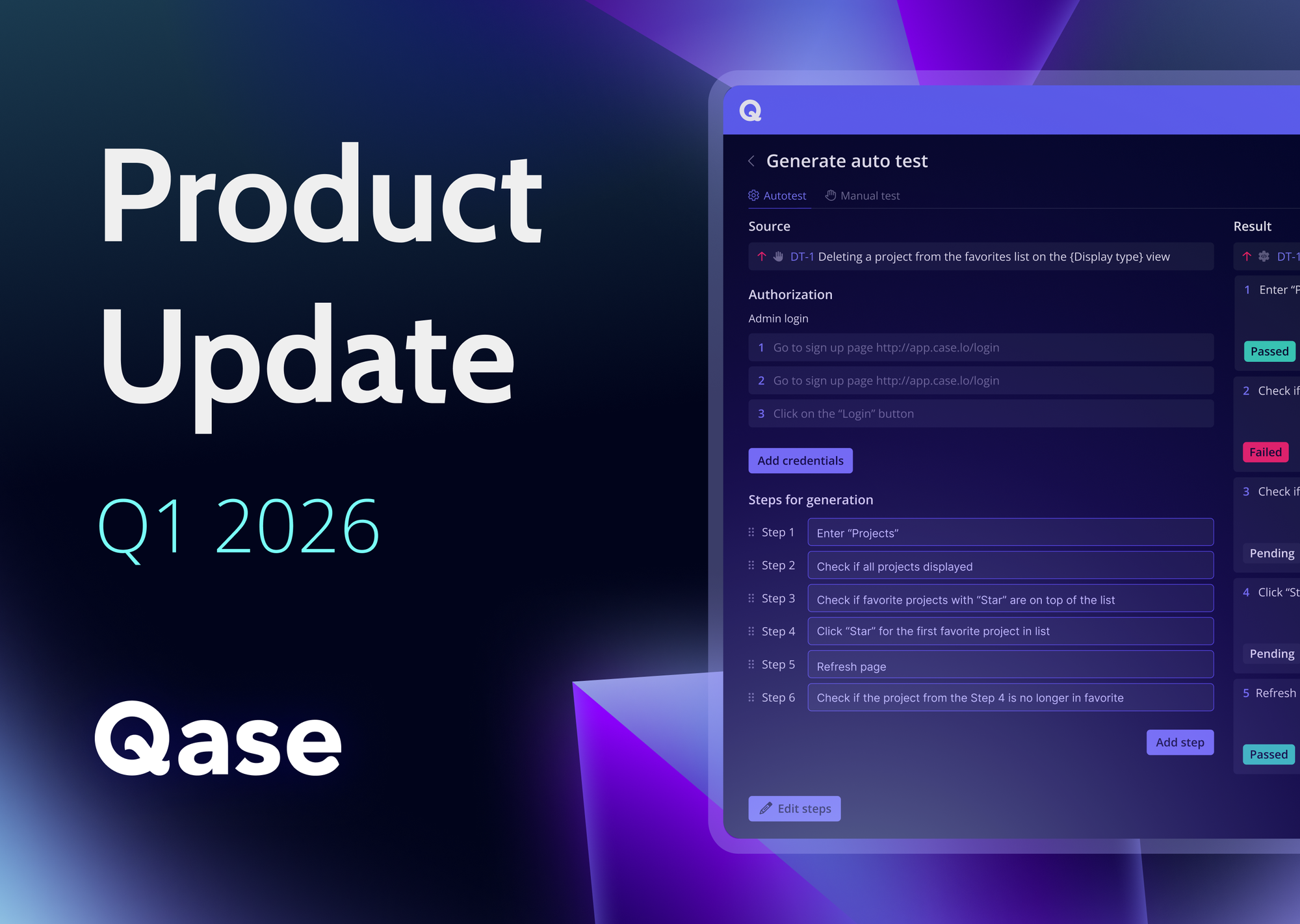
Agentic Mode. You state the goal: "Verify a user can purchase shoes on our marketplace," and AIDEN figures out the path. It breaks your natural language into actionable steps, captures screenshots for visual feedback, and generates test code. You can stay high-level or get specific: "Click 'Get a Demo' and fill the email field as '[email protected]'." AIDEN finds the field and handles the input.

Test Advisor in Folder View. Test Advisor has always helped you identify which test cases are ready for automation before you start converting. What's new this quarter is that it's now available in Folder view, and you can bulk-run it.
Select all your test cases from a folder, hit 'Run Advisor', and AIDEN analyses them in one go. Results come back color-coded: green cases are ready to automate with minimal oversight; yellow cases have good potential but are missing detail; red cases lack the steps or specificity that automation requires. Fix what needs fixing, re-analyse, then convert. No more discovering mid-generation that a test case wasn't ready.
The insight is yours, and it's also something you can share with any developer on the team who wants to contribute to test automation but isn't sure where to start.
Parameterized Test Conversion. If you've ever maintained a data-driven test suite, you know the problem: one test scenario, twelve input combinations, twelve separate test cases. Keeping them consistent when something changes is the kind of work that makes automation feel like more maintenance than it's worth.
AIDEN now handles this natively. When you convert a manual test that includes multiple input combinations, such as different usernames, passwords, and expected results, AIDEN identifies the parameterized structure, extracts the data, generates one reusable test flow, and creates individual execution instances for each combination automatically. One test. Multiple runs. All your combinations covered.

API Testing and Random Data. Tests aren't just front-ends. AIDEN can execute GET and POST API requests via CURL right in your flow, so a single test can validate both UI behaviour and the API calls underneath. And to keep your environments clean, the Random Data Generator creates unique emails, usernames, and passwords on the fly. No more hardcoded test_user_123 polluting your pre-production data.
Self-Correcting Generation. When your application changes mid-generation and a step breaks, AIDEN no longer stops and hands the problem back to you. It detects the failure, analyses what changed, and re-attempts with a corrected approach. The generation process keeps moving.
Canvas Support. Heavy <canvas> elements, tools like Miro or Figma, have always been automation dead zones. AIDEN now interprets visual elements within a canvas just like standard DOM elements. If your product includes a canvas-based UI, that coverage gap is closed.
Pillar 2: Architecting the Enterprise Test Library
When you build a mature test suite, shared steps transition from a convenience into a foundational dependency. Treat thousands of them as a flat list and you end up with the kind of codebase where nobody's quite sure what anything does, changes break things unexpectedly, and onboarding a new engineer takes two hours of tribal knowledge transfer.
We've fundamentally upgraded how you manage these assets.
Folder Structures for Shared Steps. Shared steps can now be organized into folders and subfolders by domain, like Billing, Auth, or Compliance, mirroring your actual product structure. Bulk move, clone, and rename entire directories. The shared step library now works the way a codebase should: navigable, structured, and maintainable as it grows.

Child Steps in Shared Steps. Complex systems demand modularity. You can now nest child steps directly inside shared steps, building sophisticated reusable workflows. A Checkout Flow shared step can contain the governed logic for payment, address validation, and inventory checks nested within it. Reuse at the macro level, visibility at the micro level.

Bulk Conversion and Safety. Select multiple local steps and promote them to Global Shared Steps in a single click. For cleanup, bulk delete with options to either cascade the deletion across all associated test cases or convert them back to local steps first, so you don't silently break historical data while refactoring.
Pillar 3: Data That Makes the Whole Team Look Good
Test data tells the story of your product's health. The challenge is that it usually tells that story in a way only the person who wrote the query can fully interpret. We want QA leads, engineering managers, developers, and product owners to be able to read it too.
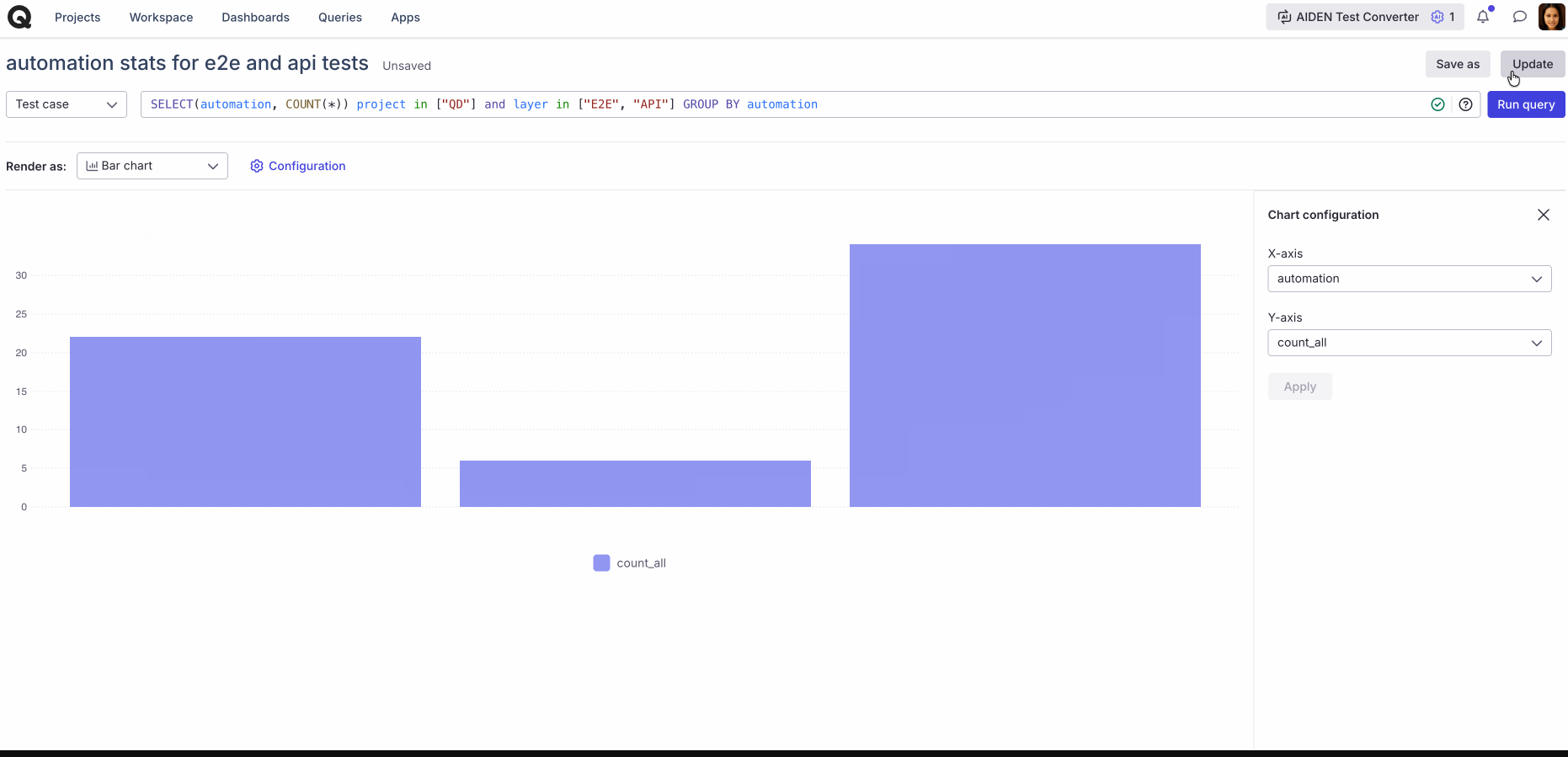
Bar Charts and Donut Charts in QQL. You can now switch any QQL result directly to a Bar Chart or Donut Chart view, save it as the default, and add it as a widget on your dashboard. Bar charts for distribution and trends; donut charts for proportion: automation coverage by business unit, test pass rates by team, coverage gaps at a glance. The work you've done to build this data deserves to be understood by the people you're presenting it to. Now it will be.
Private Queries. When you're deep in an investigation, every exploratory query you save to the public list degrades the signal for everyone else. Queries are now private by default, visible only to you and promotable to public when they prove useful to the team, but not demotable once shared. A one-way door that keeps the shared workspace clean.
Pillar 4: Powering the Complex Enterprise
The modern engineering org doesn't map neatly to "one project, one repo." Monorepos, microservices, distributed systems, multiple teams working in multiple languages: your tooling needs to reflect that reality, not ask you to simplify down to it.
GitLab Requirement Traceability. For teams that need to demonstrate that specific requirements have been validated by specific tests, whether in regulated environments, compliance-heavy orgs, or anywhere auditors ask for evidence, we've extended full requirements traceability support to GitLab. Link test cases to GitLab requirements, track which requirements have test coverage, and see which open failures are blocking a requirement from being marked satisfied. GitHub teams have had this for a while. GitLab teams now have it too.
Multi-Project Routing. Our JavaScript and Python reporters now handle monorepos natively. A single CI run that touches three product lines routes those results to the correct Qase projects simultaneously, with no custom pipelines, no post-processing, no manual splitting after the fact.
Java Reporter Performance. Result processing time in our Java reporters has been cut by 40% on large projects. If you're running a significant Java suite, this shows up directly in your pipeline times.
Network Profiler in JS Reporters. JS reporters now capture network activity alongside test results. When a test fails because of a request that timed out or returned the wrong status code, that evidence is in the report, not something you have to reconstruct from server logs after the fact.
Interactive Test Reports. We published Qase Report, a CLI tool that generates a fully interactive, standalone HTML report from your test results in a single command. No server, no dashboard login required. Share it with a stakeholder, open it in a browser, done. Full write-up: Interactive Test Reports in a Single Command.
Expanded Framework Support. We added native reporters for MSTest and xUnit v3, and open-sourced a reporter for Pest (PHP). For mobile teams, NUnit and JUnit 4 for Android. Behave now supports step-level attachments; CucumberJS gets parameter and suite annotation support; Mocha, Vitest, and Jest support expected results and input data at the step level. Jira Data Center 10.x is now officially supported, whether you're on the latest version or holding stable.
The Finishing Touches
Alongside the major pillars, we squashed 10 bugs across the platform this quarter. Not every improvement ships as a feature announcement. Sometimes it's fixing what's been quietly bothering you for three months.
We also moved our community feedback and roadmap to roadmap.qase.io. Submit requests, vote on what you want built, and track ideas as they move from submitted to in progress to shipped. If you used Canny before, your data migrates automatically. The roadmap is public, the conversation is open, and what you vote for directly shapes what we prioritise.
We're proud of what shipped this quarter, and we're even more proud of the work you do. You are the architects of software quality, and our goal is to build a platform that feels like a true partner in that work. Everything in this post is live today.
We can't wait to see what you build next.
Happy testing!
Don't miss out on future updates and valuable content! Connect with us on LinkedIn to stay informed about all things Qase.